Executive Snapshot. Indonesia’s rooftop solar framework changed on 31 January 2024, when Ministerial Regulation ESDM No. 2 of 2024 was promulgated and took effect, replacing Permen ESDM 26/2021. Five changes matter most for on-grid systems. The export-import compensation scheme that credited excess production against the electricity bill is gone. Installed capacity is now governed by a development quota instead of a fixed cap. Applications are accepted only in January and July, processed first in first served. PLN must supply and install an advanced bidirectional meter at its own cost. Parallel operation fees no longer apply.
For property developers, business owners, and sustainability managers planning rooftop solar in Indonesia, the regulatory pathway is now as decisive as the technical design. As an Indonesian solar module manufacturer with its plant in Batam and an active member of APAMSI, Apollo Solar Indonesia produces modules built to the SNI IEC 61215 series referenced in Annex I of Permen ESDM 2/2024.
For property developers planning sustainable building projects, business owners evaluating solar investment for industrial facilities, sustainability managers building decarbonisation roadmaps, and household decision-makers exploring rooftop solar, the central question in 2026 is no longer whether to install rooftop solar. It is how to navigate the Permen ESDM 2/2024 framework efficiently and secure approval within a quota window. That question is operationally critical because quota is allocated per cluster and published per registration period, and because the removal of export-import compensation changes how a system should be sized.
This article explains what Permen ESDM 2/2024 regulates and why it matters, the five key changes from the previous regulation, the application process and its timelines, the documents required at each capacity band, what happens after approval including the two compliance pathways, what existing rooftop solar owners need to know, and how a domestic solar module manufacturer fits into the compliance picture.
What Does Permen ESDM 2/2024 Regulate and Why Does It Matter for Indonesian Property Owners?
Permen ESDM 2/2024 governs rooftop solar power plants (Pembangkit Listrik Tenaga Surya Atap, or PLTS Atap) connected to the electricity network of holders of an electricity supply business licence for the public interest (Izin Usaha Penyediaan Tenaga Listrik untuk Kepentingan Umum, or IUPTLU), with PT PLN (Persero) the dominant IUPTLU holder across most of Indonesia. Its scope covers connected systems whether or not they deliver electricity into the IUPTLU holder’s network. The regulation states three purposes for rooftop solar use: reducing the customer’s electricity bill, obtaining electricity from a renewable source, and contributing to greenhouse gas emission reduction.
Four aspects of the regulation directly affect property owners:
Aspect 1: Approval must come before construction. A rooftop solar system may only be built and installed after the IUPTLU holder grants approval. A system built before approval may only operate connected to the network once approval is obtained. Where a system is found operating on the network without approval, the IUPTLU holder issues a notice requiring disconnection and payment of a penalty calculated as total inverter capacity multiplied by 240 hours multiplied by the electricity tariff. Failure to comply within one month of that notice can lead to temporary suspension of the customer’s service. Off-grid systems that do not connect to the network fall outside this regulation, although national electrical safety standards still apply.
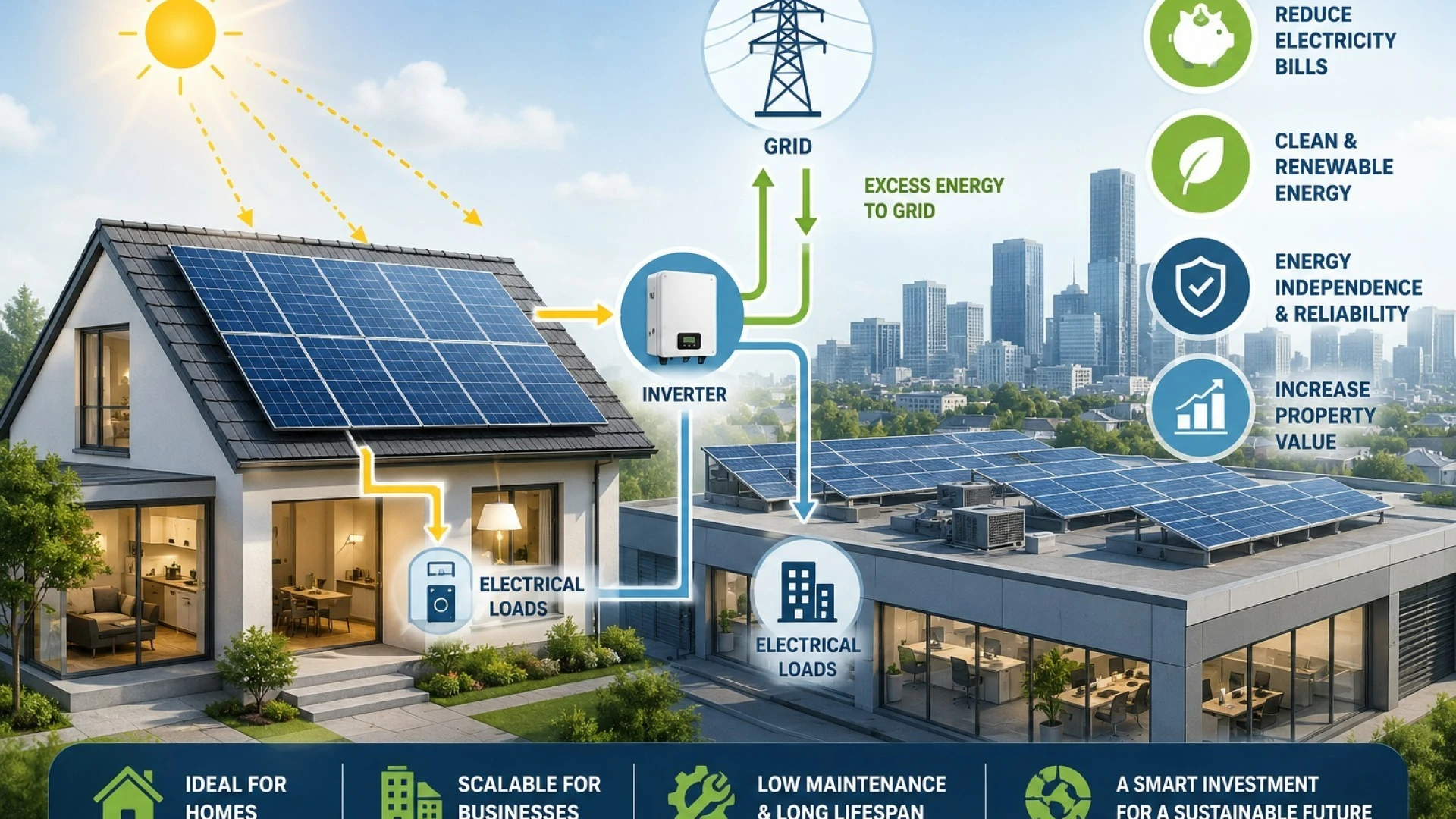
Aspect 2: Exported electricity carries no compensation. Article 13 provides that excess electricity from a rooftop solar system entering the IUPTLU holder’s network is not counted in determining the customer’s electricity bill. Separately, Article 41 prohibits rooftop solar customers from selling the electricity their system produces. Read together, these provisions mean daytime production beyond on-site consumption delivers no direct financial return unless it is stored for later use.
Aspect 3: Development is governed by quota. The IUPTLU holder prepares a rooftop solar development quota for each electricity system, covering a five-year period broken down year by year. The proposal goes to the Director General of Electricity, copied to the Director General of New, Renewable Energy and Energy Conservation, and it is the Director General of Electricity who evaluates and sets the quota. The IUPTLU holder then breaks the approved quota down by clustering at customer service unit level, reports it, and publishes it through its official website, application, and/or social media channels within ten working days of the quota being set. Quota still available at the end of a running year is added to the following year’s quota.
Aspect 4: Obligations scale with capacity. For licensing purposes, capacity is determined by total inverter capacity. Systems above 500 kW connected within one electrical installation system require a self-consumption electricity supply business licence (Izin Usaha Penyediaan Tenaga Listrik untuk Kepentingan Sendiri, or IUPTLS). Systems up to 500 kW instead carry a one-time reporting obligation to the Minister or the governor, submitted before construction begins. Industrial-tariff customers with systems above 3 MW must additionally provide a weather forecast database integrated with the IUPTLU holder’s Supervisory Control and Data Acquisition (SCADA) or smart grid distribution system.
For background on Apollo Solar Indonesia’s association membership and its role in the domestic solar module industry, see Apollo Solar Indonesia Officially Joins APAMSI: Strengthening National Solar Energy Collaboration.
What Are the Five Key Changes from Permen ESDM 26/2021?
Permen ESDM 2/2024 introduces five changes from its predecessor that property owners should understand before planning an on-grid installation: removal of the export-import compensation mechanism, replacement of the capacity cap with a development quota, fixed application periods with a defined decision clock, provision of the advanced meter by the IUPTLU holder at its own cost, and removal of the parallel operation fee.
Change 1: Export-import compensation removed. Under Permen ESDM 26/2021, excess electricity exported to the network offset consumption drawn from the network. Under Article 13 of Permen ESDM 2/2024 that offset no longer applies. System sizing must now align more closely with on-site consumption patterns, with excess daytime production delivering no billing benefit unless it is captured in storage for later use.
Change 2: Capacity cap replaced by a development quota. Under the previous regime, installed rooftop solar capacity was effectively capped in relation to the customer’s connected power. Permen ESDM 2/2024 removes that cap. Capacity is instead matched to the prospective customer’s needs, subject to the applicable development quota. Where a quota has not yet been set for an area, capacity is matched to the condition of the IUPTLU holder’s electricity system.
Change 3: Fixed application periods and a defined decision clock. Applications are submitted in January or in July each year, addressed to the IUPTLU holder with copies to both Directorates General. The IUPTLU holder must issue an approval or a rejection within 30 calendar days of the close of the application period. If no decision is issued within that period, the application is deemed approved. An application rejected because no quota is available goes onto a waiting list and is processed in a following period once quota becomes available.
Change 4: Advanced meter supplied and installed at the IUPTLU holder’s cost. The IUPTLU holder must supply and install an advanced bidirectional meter (Advanced Meter) capable of two-way measurement and communication, replacing the conventional kWh meter. Installation must take place within 15 working days of the IUPTLU holder receiving the operational worthiness certificate or evidence of the ministerial registration number. The cost of supplying and installing the meter is borne by the IUPTLU holder.
Change 5: No parallel operation fee. Rooftop solar systems built and installed by rooftop solar customers are not charged a parallel operation fee (biaya operasi paralel), and the parallel operation provisions of Permen ESDM 11/2021 no longer apply to rooftop solar use. The capacity charge (biaya kapasitas) is removed as well, across PLN customer categories rather than for industrial customers alone.
How Do You Apply for On-Grid Rooftop Solar via PLN Mobile?
The Ministry of Energy and Mineral Resources, through the Directorate General of New, Renewable Energy and Energy Conservation, operates an integrated electronic service and reporting system for rooftop solar. PT PLN (Persero) operates its own integrated application for PLN customers, connected to the ministerial system, and PLN Mobile is PLN’s official customer application. Where the electronic systems are not yet available, the regulation allows the service and reporting process to be carried out manually. Application menus and screens change between releases, so confirm the current flow through PLN’s official channels before submitting.
Step 1: Install and register PLN Mobile
Download PLN Mobile from the App Store or Google Play, then complete registration using your PLN customer identity number and verified contact details. Make sure the registered email address is actively monitored, because correspondence relating to the application is sent to the contact details submitted with it.
Step 2: Check the published quota for your service area
The IUPTLU holder publishes its clustered development quota through its official website, application, and/or social media channels within ten working days of the quota being set. Checking the published quota for your customer service unit before submitting gives a realistic view of approval prospects in the current period. Quota unused at the end of a year is carried into the following year.
Step 3: Prepare the required documents
Assemble the administrative data, technical data, planning and study documents, and project cost estimate in digital form before opening the application. The next section sets out the full checklist by capacity band. Preparing documents in advance avoids incomplete submissions inside a fixed application window.
Step 4: Submit within the application period
Submit during January or July, addressed to the IUPTLU holder with copies to the Director General of New, Renewable Energy and Energy Conservation and the Director General of Electricity. Two provisions are worth noting at this point. If your electricity tariff is paid on a prepaid basis, the same application also serves as a request to convert to postpaid, which the IUPTLU holder is obliged to approve, with the change made when the advanced meter is installed. If you already hold an electricity supply agreement with the IUPTLU holder, the application also serves as a request to adjust that agreement.
Step 5: Complete the licensing obligation for your capacity band
A system above 500 kW within one electrical installation system requires an IUPTLS, issued by the Minister or the governor under the risk-based business licensing rules. A system up to 500 kW instead requires a one-time report to the Minister or the governor, submitted before construction and installation begin. Capacity for both thresholds is determined by total inverter capacity.
Step 6: Receive the approval or rejection decision
The IUPTLU holder issues an approval or a rejection within 30 calendar days of the close of the application period. If no decision is issued within that period, the application is deemed approved. A rejection must be delivered in writing with reasons, and a rejected applicant may reapply. Where the rejection is due to unavailable quota, the applicant goes onto a waiting list for processing in a following period.
What Documents Are Required for the On-Grid Application?
The application form set out in Annex II of the regulation has three parts: administrative data, technical data, and an estimate of total project cost. Planning and study documents scale with system capacity. One distinction matters when reading the tables below: the document bands in Annex II are expressed in kWp, while the thresholds for licensing and for the operational worthiness certificate are determined by total inverter capacity.
Administrative Data
| Item | Description |
|---|---|
| Rooftop solar customer identity number | The identifier from your existing PLN electricity account |
| Customer name | As registered on the electricity account |
| National identity number (NIK) | Indonesian citizen identification |
| Taxpayer identification number (NPWP) | Personal or corporate tax identification number |
| Full address | Street, village, sub-district, regency or city, and province |
| Telephone number | Active contact number |
| Email address | Correspondence on the application is sent to the contact details submitted |
| Electricity tariff payment mechanism | Prepaid or postpaid. A prepaid application also serves as a request to convert to postpaid |
| Existing electricity supply agreement | If one is held, the application also serves as a request to adjust it |
Technical Data and Cost Estimate
| Item | Description |
|---|---|
| Connected power (VA) | Current contracted electricity capacity |
| Appointed business entity | The certified electricity support services company that will carry out the work |
| Single line diagram | Schematic of the proposed rooftop solar system configuration |
| Operating plan | Industrial tariff customers only |
| Equipment specifications | Brand, type, country of manufacture, year of manufacture, capacity per unit, and number of units for solar modules, inverter, and battery where fitted |
| Estimated total project cost | Total estimated cost of construction and installation |
Planning and Study Documents by Capacity Band (kWp)
| Document | <10 | 10–100 | 100–500 | 500–3,000 | >3,000 |
|---|---|---|---|---|---|
| Inverter protection data sheet including anti-islanding function | ✓ | ✓ | ✓ | ✓ | ✓ |
| Planning document: earthing system, over-current protective device, surge, over/under voltage | – | ✓ | ✓ | ✓ | ✓ |
| Projected kWh production data | – | ✓ | ✓ | ✓ | ✓ |
| Planning document: over/under frequency | – | – | ✓ | ✓ | ✓ |
| Daily load projection | – | – | ✓ | ✓ | ✓ |
| Short-circuit analysis | – | – | ✓ | ✓ | ✓ |
| Load flow study | – | – | ✓ | ✓ | ✓ |
| Harmonic impact document | – | – | ✓ | ✓ | ✓ |
| Stability study | – | – | – | ✓ | ✓ |
| Weather forecast database configuration | – | – | – | – | ✓ |
Construction and installation must be carried out by a business entity (Badan Usaha) holding the relevant electricity support services certification, in compliance with electrical safety regulations.
What Happens After PLN Approves Your Application?
After approval, the project moves through construction, a safety compliance step on one of two pathways, meter installation, and operational start. Which pathway applies, and the deadline attached to it, depends on the system’s capacity and configuration.
Step 1: Construction by a certified business entity. The appointed business entity carries out the physical installation, which must follow Indonesian National Standards and/or applicable international standards and comply with electrical safety regulations. The use of rooftop solar equipment must also comply with Indonesian regulations on the use of domestic goods and services. Annex I of the regulation sets the technical standards: solar modules to SNI IEC 61215-1:2016, SNI IEC 61215-2:2016 and SNI IEC 61215-1-1:2016; combiner boxes, AC and DC conductors, protective devices, switchgear and system earthing to SNI 0225:2020 (PUIL 2020); and inverters carrying, at minimum, anti-islanding, over/under frequency, over/under voltage, over-heat protection, surge arrester, over-current protection, and DC ground fault detection.
Step 2: Safety compliance on one of two pathways. The regulation provides two routes, and choosing the wrong one is a common source of delay.
The operational worthiness certificate pathway applies to systems above 500 kW, and to systems up to 500 kW whose control panel specification forms a separable part. The certificate (Sertifikat Laik Operasi, or SLO) is issued by a technical inspection institution (lembaga inspeksi teknik). It must be obtained within six months of IUPTLU approval.
The registration number pathway applies to a system up to 500 kW that uses a single inverter, or several inverters totalling below 10 kW, with the module array on the same building structure, within the same earthing arrangement, serving a single utilisation installation, and operable on a plug and play basis. Such a system is deemed to have satisfied the certificate obligation. It requires a statement of responsibility for electrical safety from the installation owner or the business entity, supported by a product certificate, a valid manufacturer warranty, commissioning test results from a distributor technician or the business entity, or generation installation maintenance records. The Minister evaluates the documents and issues a registration number, which must be obtained within three months of IUPTLU approval.
Missing either deadline results in the IUPTLU holder cancelling the approval, which means reapplying in a future application period.
Step 3: Advanced meter installation. Within 15 working days of receiving the certificate or the evidence of the registration number, the IUPTLU holder supplies and installs the advanced bidirectional meter at its own cost. Customers converting from prepaid to postpaid make that change at the same point.
Step 4: Operational start and ongoing obligations. With the meter installed, the system begins operation, supplying on-site consumption, with any excess flowing to the network without billing compensation. Customers on industrial tariffs must periodically report their rooftop solar operating plan to the IUPTLU holder. One point deserves attention from sustainability teams: the carbon economic value of rooftop solar use follows the applicable regulations, and where no such regulation exists, that value belongs to the Government. Carbon accounting assumptions should be built on that basis rather than on an assumed private claim to the credits.
What Do Existing Rooftop Solar Owners Need to Know?
Systems already operating and connected to the IUPTLU network before Permen ESDM 2/2024 took effect, and already using the export-import calculation and capacity charge provisions, continue under those provisions for ten years from the date they received IUPTLU approval. The same ten-year continuation applies to customers who had received approval but had not yet begun operating. If such a customer applies to change capacity from the original application, the system moves onto the Permen ESDM 2/2024 regime.
Systems that were already operating on the network but had never been reported to the IUPTLU holder were required to be reported within three months of the regulation being promulgated. Systems that remain unreported fall under the unapproved-operation provisions described earlier, including the penalty calculation and the possibility of temporary service suspension.
How Does Apollo Solar Indonesia Support On-Grid Rooftop Solar Adoption?
Apollo Solar Indonesia is an Indonesian solar module manufacturer with its manufacturing plant in Batam, Riau Islands Province, and an active member of APAMSI. Permen ESDM 2/2024 requires that the use of rooftop solar equipment comply with Indonesian regulations on the use of domestic goods and services, which places domestically manufactured modules directly in line with the regulation rather than merely adjacent to it.
On the technical side, Annex I sets the solar module standard for on-grid rooftop solar at the SNI IEC 61215 series. It is worth being precise about scope here, because the point is frequently blurred in market communication: anti-islanding and the other minimum protection functions listed in Annex I are inverter requirements, not module requirements. System designers should confirm compliance component by component rather than assuming a single certificate covers the whole system.
The Apollo portfolio covers residential, commercial, industrial, and utility-scale on-grid applications. The APM7-UH108 Series delivers power output in the 415 to 435 watt range, with maximum module efficiency of up to 22.28 percent, annual degradation of 0.50 percent, a 12-year product warranty, and a 25-year output guarantee. The APM7-UHLD108 Series, a double-glass variant, reduces annual degradation to 0.40 percent and extends the output guarantee to 30 years, which suits commercial rooftops and industrial installations planned around long asset lives.
For owners preparing an application, working with domestically manufactured modules offers several practical points. The modules are designed and tested for Indonesian operating conditions, including sustained high temperature, humidity, and tropical irradiance patterns. Product documentation, including module datasheets and product certificates, is available for the application file, and the same product certificate is one of the supporting documents accepted on the registration number pathway. After-sales support and warranty service run through domestic channels. And specifying a domestically manufactured module supports the national solar manufacturing base that the regulation’s domestic content provision is designed to strengthen.
In practice, the decisive factors in a successful application are procedural rather than technical, submitting inside the January or July window, appointing a properly certified business entity, sizing the system against on-site daytime consumption now that exported electricity carries no compensation, and completing the certificate or registration number step within its deadline.
Apollo Solar Indonesia works with project developers, EPC contractors, and installers preparing on-grid rooftop solar applications. To request module datasheets and product certificates for your application file, or to discuss module selection for a specific project, visit apollosolarindonesia.com.
Learn more at apollosolarindonesia.com.
Notes
This article summarises Permen ESDM 2/2024 for general information and does not constitute legal advice. Quota figures, application channels, and in-app procedures change between registration periods. Confirm current details through the official channels of the Ministry of Energy and Mineral Resources and PT PLN (Persero) before submitting an application.
Source List
Ministry of Energy and Mineral Resources of the Republic of Indonesia. Peraturan Menteri ESDM Nomor 2 Tahun 2024 tentang Pembangkit Listrik Tenaga Surya Atap yang Terhubung pada Jaringan Tenaga Listrik Pemegang Izin Usaha Penyediaan Tenaga Listrik untuk Kepentingan Umum. Signed 29 January 2024, promulgated 31 January 2024, State Gazette of the Republic of Indonesia 2024 No. 70. jdih.esdm.go.id
Permen ESDM 2/2024, Annexes I to V: technical specification standards, application form, report format, statement of responsibility format, and commissioning requirements.
Ministry of Energy and Mineral Resources of the Republic of Indonesia. Peraturan Menteri ESDM Nomor 26 Tahun 2021 tentang Pembangkit Listrik Tenaga Surya Atap, revoked and replaced by Permen ESDM 2/2024.
Ministry of Energy and Mineral Resources. Press release, “Aturan Terbaru PLTS Atap Terbit, Kini Kapasitas Pemasangan Tidak Dibatasi”, 5 March 2024. esdm.go.id
Directorate General of New, Renewable Energy and Energy Conservation (EBTKE). “Telah Terbit: Peraturan Menteri ESDM Nomor 2 Tahun 2024”, 20 February 2024. ebtke.esdm.go.id
SNI IEC 61215-1:2016, SNI IEC 61215-2:2016, and SNI IEC 61215-1-1:2016. Terrestrial photovoltaic module design qualification and type approval.
SNI 0225:2020. Persyaratan Umum Instalasi Listrik (PUIL 2020).