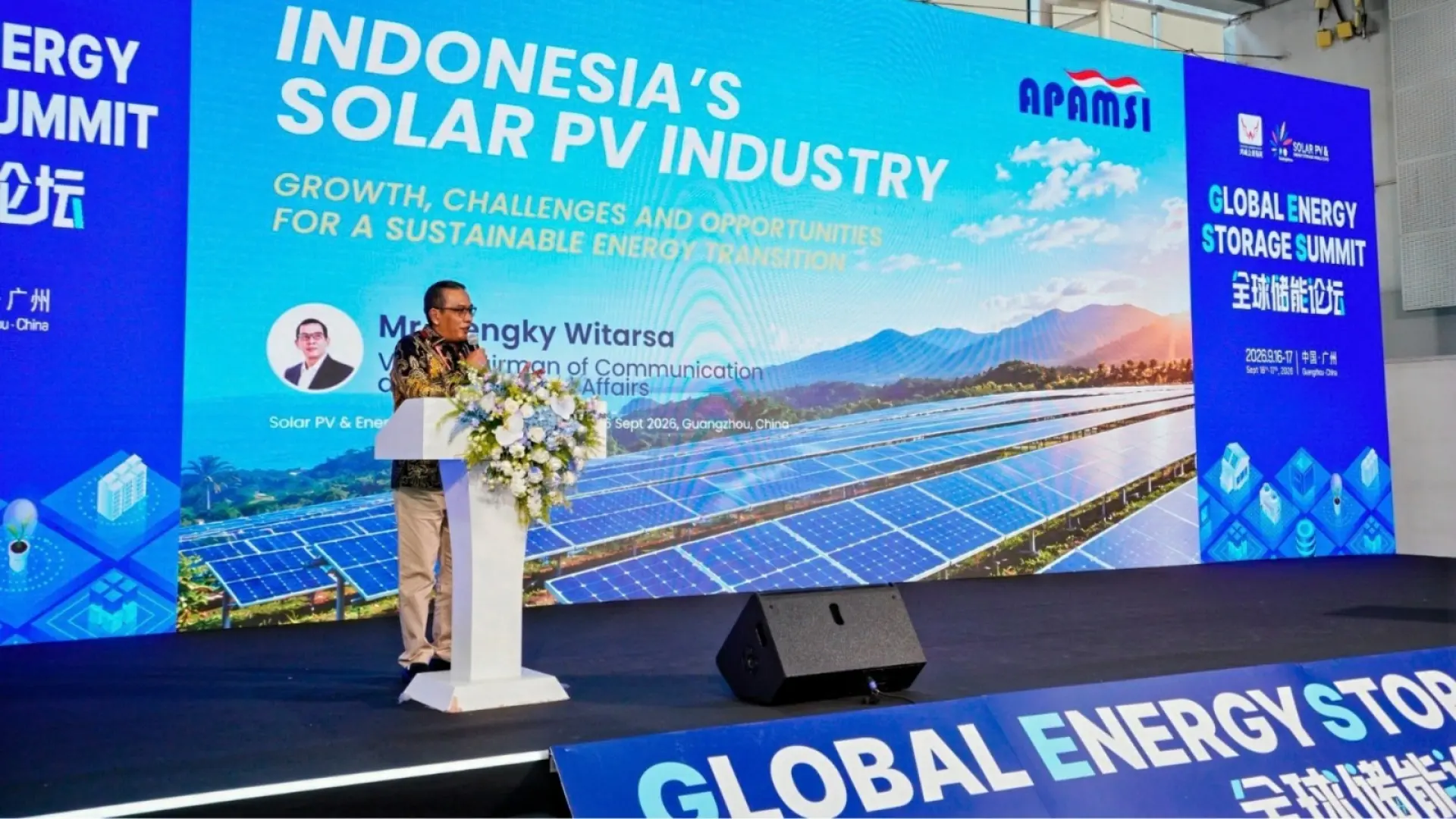
At the Global Energy Storage Summit 2026, Hengky Witarsa sets out where Indonesia's solar supply chain is open to Chinese partners.
GUANGZHOU, China, 17 September 2026. The Indonesian Solar Module Manufacture Association (APAMSI) presented an updated roadmap of the national photovoltaic industry at the Global Energy Storage Summit in Guangzhou. The summit runs from 16 to 18 September 2026.
The presentation was delivered by Ir. Hengky Witarsa, DJ, S.T., Vice Chairman of Communication & Institutional Affairs at APAMSI, who also serves as Chief Operations Officer at Apollo Solar Indonesia. Titled Indonesia's Solar PV Industry: Growth, Challenges & Opportunities for a Sustainable Energy Transition, the session positioned Indonesia as a growing solar market with a much larger development pipeline still ahead.
New Momentum from the 100 GWp Solar PV Programme
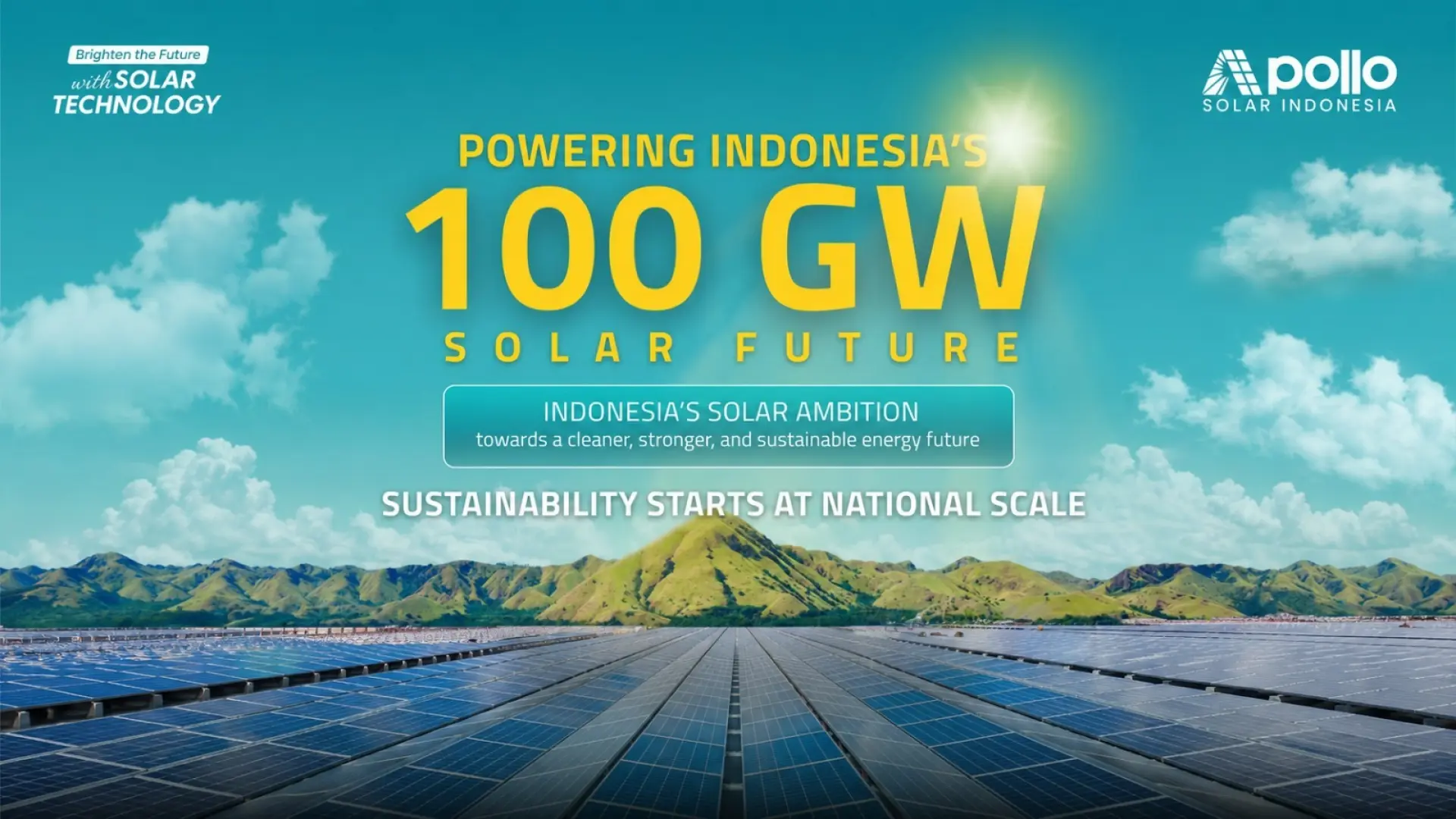
On 25 August 2026, President Prabowo Subianto officially launched the 100 gigawatt-peak (GWp) Solar PV Programme in Bali. The programme forms part of the government's effort to strengthen national energy independence and resilience.
The initial phase covers 14 solar plants across six provinces with a combined capacity of 5.3 GWp. The national target of 100 GWp is to be reached within three years, consistent with Indonesia's commitment to achieving Net Zero Emissions (NZE) by 2060 or sooner.
The gap between current capacity and that target remains wide. As of April 2026, installed solar PV capacity in Indonesia stood at approximately 1.5 GWp.
A Manufacturing Base Is Already in Place
The presentation underlined that Indonesia is not starting from zero. Thirty-four solar module factories are already operating in the country, with a total production capacity of 10,944 megawatts (MW) per year, of which 4,300 MW is earmarked for export markets. Total investment in the national solar module industry stands at IDR 11 trillion.
APAMSI's 21 member companies hold a combined module production capacity of 5.9 GWp and a solar cell production capacity of 14.3 GWp per year. Together they employ 2,572 people.
Domestic manufacturers already run both P-type and N-type lines, including TOPCon and back-contact technologies, with ratings of up to 720 watt-peak (Wp) per module. Their products meet international standards as well as domestic and export market requirements. New facilities continue to be added to raise capacity and efficiency.
Upstream Segments Remain Open Ground
The session also mapped Indonesia's position along the solar value chain. The downstream segments, solar cell manufacturing and solar module manufacturing, are established domestically.
The upstream segments are not yet in place. Silicon refining and polysilicon production, silicon ingot manufacturing, and the wafer industry remain the largest gaps and the clearest openings for new industrial capacity.
Hengky Witarsa framed that gap as the basis for industrial cooperation with global partners.
Complementary Strengths Between Indonesia and China
The closing section set out where the two countries complement one another. China contributes photovoltaic technology and supply-chain experience, while Indonesia offers a growing solar market, an existing manufacturing base, and regional market potential.
He closed by positioning the 100 GWp programme as more than a matter of added generation capacity, presenting it as an opportunity to build a more integrated domestic solar supply chain through technology collaboration and investment.
About APAMSI
The Indonesian Solar Module Manufacture Association (APAMSI) was established on 17 August 2010 in Bandung as the industry body for Indonesian solar module manufacturers. It works to strengthen the competitiveness of domestic manufacturers and their products by developing quality standards, harmonising regulation, and reinforcing the national supply chain. More information is available at apamsi.org.
About Apollo Solar Indonesia
PT Apollo Solar Indonesia is an Indonesian solar module manufacturer established in March 2022 and headquartered in Jakarta. Its plant at Wiraraja Industrial Estate, Kabil Nongsa, Batam City, Riau Islands Province, was completed in February 2023 and runs an automated module production line with an annual capacity of 600 MW.
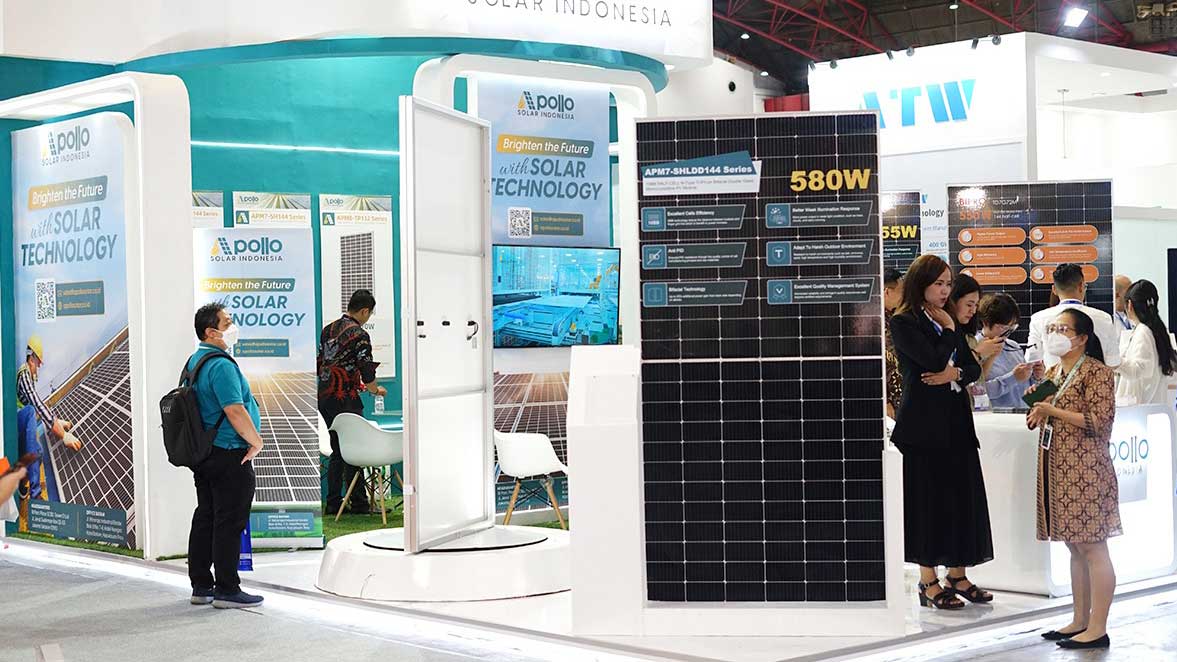
The company produces monocrystalline PERC and N-type TOPCon bifacial modules ranging from 390 W to 670 W, with module efficiency of up to 24.06 per cent. Its products are certified to IEC 61215 and IEC 61730, and carry TÜV, CSA, CB, CE, salt mist, ammonia and PID certification. The company also holds ISO 9001, ISO 14001 and ISO 45001 certification, along with a 40.00 per cent domestic content (TKDN) rating issued by the Indonesian Ministry of Industry.
Cumulative shipments have passed 1.8 million units, including export deliveries to the United States and Japan. Apollo Solar Indonesia has committed to supporting Indonesia's 100 GWp Solar PV Programme with domestically manufactured modules. More information is available at apollosolarindonesia.com.