Understanding Rooftop Solar PV: An Energy-Saving Solution for Homes and Businesses
03 Juli 2026
•
9 mins read
Indonesia receives some of the highest solar irradiance levels in Southeast Asia, yet only a small fraction of its rooftops have been put to work generating electricity. As of June 2023, Indonesia's installed rooftop solar PV capacity stood at just 95 megawatts, with 72 percent coming from household installations (PVKnowhow, 2026). For a tropical archipelago of more than 17,000 islands, that number leaves a vast amount of unused potential overhead. The government's recent quota allocation of 5,746 megawatts of rooftop solar capacity to be developed between 2024 and 2028 (IESR, 2024) signals a clear direction: rooftop solar is moving from a niche choice for sustainability enthusiasts to a mainstream energy strategy for homes, businesses, and industries across the country.
This article explains what rooftop solar photovoltaic systems are, how they work, what benefits they offer for residential and commercial users, and what to consider before installing one in Indonesia today.
What Is Rooftop Solar PV
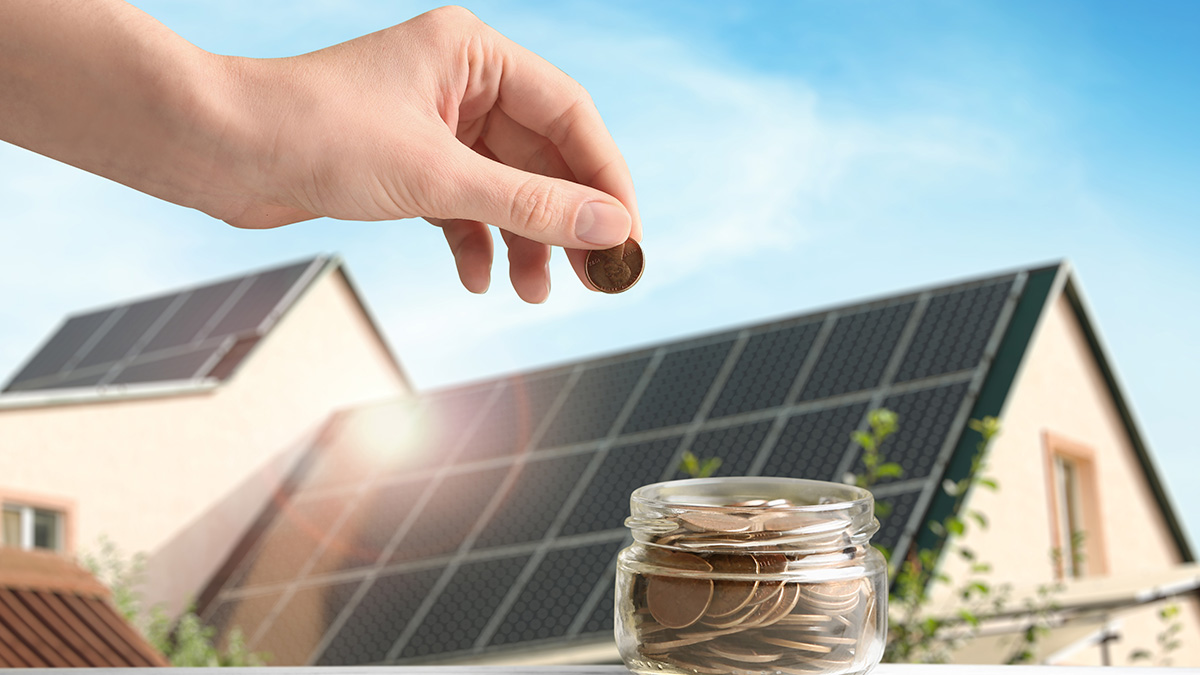
A rooftop solar photovoltaic (PV) system is an electrical installation that generates electricity through solar panels mounted on the roof or integrated into the façade of a building. Sunlight striking the panels excites electrons in semiconductor cells, producing direct current (DC) electricity. An inverter then converts this DC into alternating current (AC), the form of electricity used by home appliances, office equipment, and industrial machinery.
The energy produced is used first for the building's own consumption. Any surplus can be fed back into the public grid, stored in a battery for later use, or simply curtailed depending on the system's configuration. Most rooftop PV systems installed in Indonesia today fall into three categories:
On-grid systems connect directly to the PLN grid. Excess electricity flows to the grid, and the building draws from the grid when solar production is insufficient (such as at night or during overcast days).
Off-grid systems operate independently of the grid and rely on batteries to store electricity for use when the sun is not shining. Common in remote areas without reliable grid access.
Hybrid systems combine grid connection with battery storage, offering both reliability during outages and the ability to use stored solar power outside daylight hours.
For most homes and businesses in urban and suburban Indonesia, on-grid systems offer the most cost-effective starting point, while hybrid configurations are gaining traction in regions with frequent outages or among users who prioritize energy independence.
How a Rooftop Solar PV System Generates Savings
Rooftop solar PV reduces the amount of electricity a building has to buy from PLN. The economics depend on three variables: how much sun the rooftop receives, how efficient the panels are at converting that sunlight into electricity, and the local electricity tariff.
Indonesia's tropical location gives it a structural advantage. A well-oriented rooftop in most parts of the country can produce between 4 and 5 kilowatt-hours per kilowatt-peak installed per day, year-round. For a typical 5 kWp residential system, that translates to roughly 600 to 750 kWh per month of solar electricity.
A recent peer-reviewed study assessing rooftop solar viability in Indonesia's fast-moving consumer goods (FMCG) sector found that a 599 kWp commercial installation could achieve a payback period of 3.73 years, a return on investment of 570 percent over the system's 25-year life, and yearly savings of approximately Rp 1.36 billion (about USD 89,000) at a Levelized Cost of Energy of Rp 261.40 per kWh, compared with PLN's unsubsidized tariff of Rp 1,444.70 per kWh (Energies, 2025). The math becomes more compelling at scale, but even modest residential systems begin paying for themselves through reduced monthly electricity bills.
Key Benefits for Homes and Businesses
The advantages of installing rooftop solar PV extend beyond electricity bill reduction.
Lower operating costs. Once installed, sunlight is free. A rooftop solar system shifts a portion of recurring monthly electricity costs into a one-time capital investment that pays back over years and then continues producing free electricity for the remainder of its useful life.
Hedge against tariff increases. Electricity tariffs tend to rise over time. Generating your own electricity insulates your operation against future PLN tariff adjustments, providing predictability in long-term operating costs.
Reduced carbon footprint. Each kWh of solar electricity displaces a kWh that would otherwise be generated from coal, gas, or diesel. For businesses pursuing ESG goals or aligning with Indonesia's net zero commitments by 2060, rooftop solar contributes directly to scope 2 emissions reduction.
Improved building value. Properties with installed solar systems command higher resale or lease values in many markets, particularly for commercial buildings where sustainability features are increasingly part of tenant expectations.
Resilience during grid outages. Hybrid systems with batteries can keep critical loads running during blackouts. Indonesian customers experienced an average of 19 hours of blackout time and nearly 13 outage events per year in recent surveys (PVKnowhow, 2026), making backup capability genuinely valuable.
Support for Indonesia's energy transition. Rooftop solar contributes to the national target of 23 percent renewable energy in the primary energy mix and supports the country's broader transition agenda.
The 2026 Regulatory Landscape in Indonesia
The current regulatory framework for rooftop solar in Indonesia is governed by Ministry of Energy and Mineral Resources Regulation No. 2 of 2024 (Permen ESDM 2/2024), which took effect on 31 January 2024 and replaced the earlier Permen ESDM 26/2021. Several changes are important for prospective installers to understand.
First, the previous net-metering scheme has been removed. Under the old rules, surplus electricity exported to the grid offset a portion of the customer's electricity bill at favorable rates. Under the new framework, exports are no longer counted as bill reduction, which shifts the economic case toward self-consumption.
Second, the new regulation introduces a quota system. The total national quota of 5,746 megawatts is allocated across 11 power systems and distributed over five years, with 1,065 megawatts available specifically in 2026 (IESR, 2024). Quotas are released in two annual registration windows.
Third, applications now go through the PLN Mobile application. Approval timelines are capped at 30 calendar days for standard installations.
These regulatory shifts mean that the economic case for rooftop solar in 2026 is strongest for commercial and industrial customers with high self-consumption profiles, though residential systems remain attractive in homes with substantial daytime electricity use.
What to Consider Before Installing
A successful rooftop solar installation depends on several factors that should be evaluated before committing to a purchase.
Rooftop suitability. The roof should have sufficient unshaded area, structural capacity to support panel weight (typically 12 to 20 kg per square meter for the complete system), and an orientation that maximizes sun exposure. North-facing or east-west orientations work well in Indonesia, with tilt angles of 5 to 15 degrees common.
Electricity consumption pattern. Systems that align production with consumption are more economical under the current regulatory framework. Businesses operating during daylight hours benefit most.
System sizing. Oversizing a system relative to consumption is no longer rewarded by net-metering credits. Right-sizing based on average monthly electricity bills, available roof space, and budget gives the best economic outcome.
Panel technology and quality. Most rooftop systems in 2026 use monocrystalline panels with efficiencies of 21 to 25 percent. The most advanced panels use N-Type TOPCon technology, which delivers higher efficiency, better low-light performance, and lower degradation than traditional PERC (Passivated Emitter Rear Contact) cells. Bifacial double-glass panels generate electricity from both sides, capturing reflected light from the rooftop surface for an additional 5 to 15 percent energy yield. Panel quality affects long-term performance, warranty terms (typically 25 to 30 years for power output), and degradation rates (the best panels degrade only 0.4 percent per year).
Local manufacturing and TKDN. Choosing panels manufactured domestically can support local industry, meet government procurement requirements where applicable, and ensure smoother after-sales service. Indonesia's domestic panel manufacturing capacity has grown significantly, with manufacturers in Batam and other industrial zones supplying both local and regional markets.
Installer credentials. A qualified installer should hold relevant certifications, demonstrate proper installation practices including grounding and surge protection, and provide clear documentation for PLN application and ongoing maintenance..
For business owners ready to move from planning to execution: see our detailed companion guide,"Solar Panel Installation for Business: A Complete Guide to Going Solar", which walks through the physical installation process step by step, including panel mounting, electrical wiring, and inverter installation.
Apollo Solar Indonesia Product Lineup: Matching the Right Series to Your Application
Apollo Solar Indonesia manufactures solar PV modules at a 500 MW per year facility in Batam, Riau Islands, completed in February 2023 (Apollo Solar Indonesia, 2026). As a PMDN (Penanaman Modal Dalam Negeri) company with an Indonesian brand, Apollo produces four series of solar modules, each engineered for different use cases and budget profiles. Understanding which series fits your installation is the first step toward an optimal investment.
Bali Series: Premium Choice for Homes and Commercial Buildings
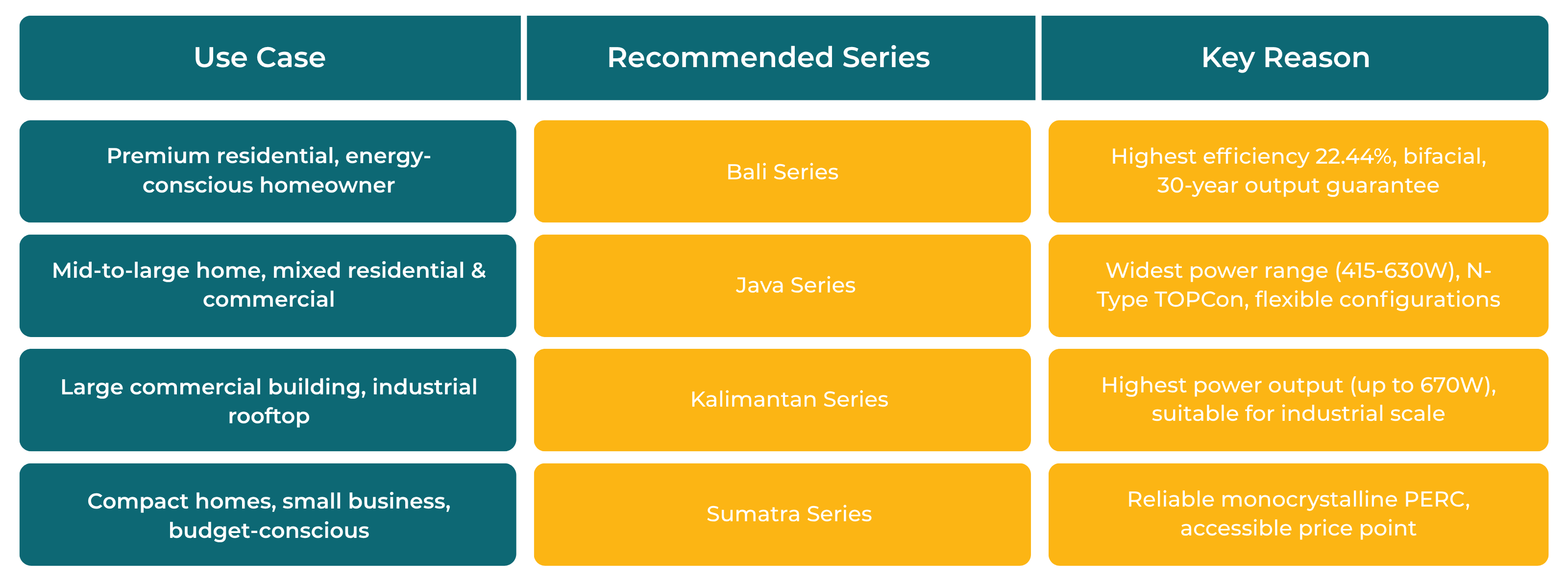
The Bali Series sits at the high-performance end of Apollo's lineup. It features 10BB HALF-CELL design with N-Type TOPCon Bifacial Double Glass technology, delivering maximum efficiency up to 22.44 percent and power output ranging from 555W to 580W per module. With an annual degradation rate of just 0.4 percent, a 12-year product warranty, and a 30-year output guarantee, the Bali Series is the right choice for homeowners and businesses willing to invest in the latest cell technology for maximum long-term yield. Bifacial operation lets the panels generate additional energy from light reflected off the rooftop surface, ideal for installations with light-colored or reflective roofs.
Java Series: Versatile Premium for Various Energy Needs
The Java Series represents Apollo's most versatile premium offering, with 16BB HALF-CELL N-Type TOPCon technology and efficiency up to 22.54 percent, the highest in the lineup. Power output ranges from 415W to 630W, the widest range in the catalog, available in standard, double glass, and bifacial double glass configurations. Annual degradation is between 0.40 and 0.50 percent, backed by a 12-year product warranty and 25-to-30-year output guarantee. The Java Series suits applications requiring flexibility, from compact residential rooftops to large commercial installations, and benefits from the same cutting-edge N-Type TOPCon technology found in the Bali Series.
Kalimantan Series: Built for Commercial and Industrial-Scale Installations
The Kalimantan Series is engineered for the broadest installation footprint, from residential to industrial-scale projects. It uses 12BB HALF-CELL Monocrystalline PERC technology with efficiency up to 21.57 percent and power output ranging from 535W to 670W, the highest in Apollo's lineup. Available in standard single-glass and bifacial double-glass options, the Kalimantan Series offers flexibility for diverse environments. Annual degradation of 0.45 percent, a 12-year product warranty, and up to 30-year power output guarantee make it suitable for large commercial rooftops, industrial facilities, and utility-scale installations.
Sumatra Series: Reliable Entry Choice for Households and Small Businesses
The Sumatra Series offers a robust and efficient entry point into Apollo's product range. Built with 10BB HALF-CELL Monocrystalline design and PERC PV technology, it delivers efficiency up to 21.48 percent and power output ranging from 530W to 555W. With an annual degradation of 0.55 percent, a 12-year product warranty, and a 25-year output guarantee, the Sumatra Series is well-suited for homeowners and small businesses seeking reliable performance at an accessible price point.
For homes and businesses ready to take the step toward solar, the path begins with a site assessment, a clear understanding of consumption patterns, and a conversation with the Apollo Solar Indonesia team to match the right series to your application. Business owners looking for a deeper walkthrough of the installation process itself can refer to our complementary guide on Solar Panel Installation for Business.
Sources
Institute for Essential Services Reform (IESR). (2024). "Rooftop Solar PV Quota Allocation 2024 to 2028."
PVKnowhow. (2026). "Indonesia Solar Panel Manufacturing Report: Market Analysis and Insights."
Energies, MDPI. (2025). "Assessing the Viability of Rooftop Solar PV in Energy-Intensive Industries: A Techno-Economic and Safety Framework for the Indonesian FMCG Sector."
Sustainability Atlas. (2026). "Solar Panel ROI in 2026: Costs, Savings, and Payback by System Size and Region."
Ministry of Energy and Mineral Resources of the Republic of Indonesia. (2024). "Regulation No. 2 of 2024 on Rooftop Solar Power Plants Connected to the Electricity Network of Holders of Electricity Supply Business Licenses for Public Interest."
BloombergNEF. (2025). "Global Solar Module Price Trends 2024."
International Energy Agency (IEA). (2025). "Renewables Market Update."
EnergyTrend. (2024). "Indonesia Issues New Quota for Rooftop Solar System Development."
Apollo Solar Indonesia. (2026). "Product Catalog: Bali, Java, Kalimantan, and Sumatra Series."